Emerging Technologies
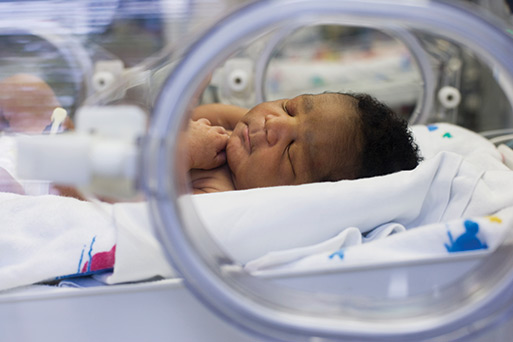
With the development of artificial womb technology (AWT), very premature babies (at or before 23 weeks) could continue to live and develop in an external womb. This technology could be helpful for the continued development of babies experiencing abnormalities and threats to their health. AWT is specifically for growing babies who would not react well to the current methods of neonatal care. Babies older than 23 weeks typically respond to the other options in neonatal care, but babies under 23 weeks have not developed enough to survive under current neonatal care conditions.
AWT utilizes a polyethylene bio-bag that is filled with fluid, made to replicate amniotic fluid. AWT also requires advanced technology to connect to the fetus’s umbilical cord and continue to transfer nutrients throughout development.
AWT is still in the beginning stages of development and has yet to be approved by the FDA for clinical testing. AWT has only been tested on lambs, piglets, and other young animals. To begin a clinical trial, the FDA must approve the AWT technology, and be convinced that babies who try AWT will flourish. Many hope that AWT will be a monumental medical advancement in neonatal care to offer developmental support for babies who need it.
The question many bioethicists wrestle with is exactly that. Which babies need it? Many ethicists have speculated that AWT could be used to restrict abortion. Vardit Ravitsky, president of The Hastings Center, a bioethics organization and think tank, explains this political concern. She writes,
“Most researchers currently think that using this technology in the early first trimester when most abortions occur, would be impossible. Yet science is ever innovative, and one can imagine a dystopian future in which it may be possible to say to a pregnant person: If you do not wish to carry this pregnancy any longer, we can separate you from the fetus and transfer it into an artificial womb.”
As Ravitsky notes, many ethicists and doctors refer to this technology as “dystopian” or “science fiction.” However, as Kenneth Shields, assistant professor of philosophy at the University of Indianapolis argues, AWT is a useful topic of discussion for both sides of the political spectrum.
Shields argues that the development of AWT could change perspectives on adoption. He writes, “Telling a woman that ‘adoption is always an option’ in this future need no longer convey a disregard for her welfare or bodily autonomy (as it frequently does today). In such a future, there needn’t be any conflict between a right to one’s body and fetal rights.” This would be an important development for advocates of adoption. However, this may raise other concerns about the cost of AWT, and how it would affect the foster care and adoption system.
Some would make the case that there are many benefits of AWT besides the care and life of the premature baby. Researchers say that AWT may enable infertile parents to conceive a child and still be biological parents by facilitating an extracorporeal (external) pregnancy. Additionally, an extracorporeal pregnancy could be an alternative to surrogacy.
It is important to note that the long-term effects of AWT will not be known for some time. It is unknown how AWT could affect a baby long-term. AWT is an important development in neonatal care, but it is unclear if or how AWT will affect the abortion debate.